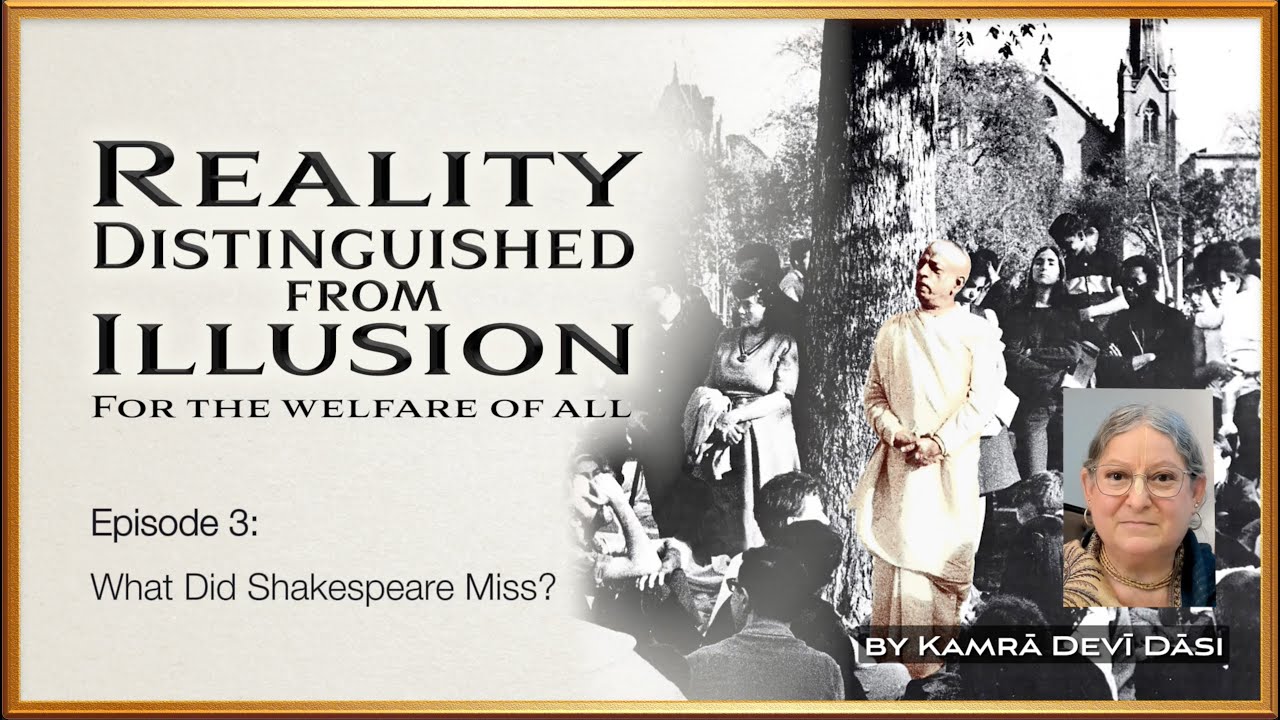
Welcome to the Purely Prabhupada YouTube channel. This video series is called “Reality distinguished from illusion for the welfare of all.” My name is Kamra devi dasi, and I am a disciple of His Divine Grace A.C. Bhaktivedanta Swami Srila Prabhupada.
This is the third video of the series. It is called, “What did Shakespeare miss?”
Srila Prabhupada said that any educated man knew some Shakespeare. We were raised studying Shakespeare in school and my parents also had a full set of Shakespeare’s works on special shelves that were inset on the door of our large storage closet. There were some things that could never be forgotten, like “out, damned spot” spoken by Lady Macbeth in her nightmare scene, Hamlet’s ‘To Be Or Not To Be’ Speech from Act 3 Scene 1, or, also from Hamlet, “To thine own self be true,” which is often quoted without reference to the full verse, “This above all: to thine own self be true, And it must follow, as the night the day, Thou canst not then be false to any man.”
What I recalled the most clearly, though, was the monologue from As You Like It, beginning “All the world’s a stage.” This monologue is also known as “The Seven Ages of Man.”
All the world’s a stage,
And all the men and women merely players;
They have their exits and their entrances,
And one man in his time plays many parts,
His acts being seven ages. At first, the infant,
Mewling and puking in the nurse’s arms.
Then the whining schoolboy, with his satchel
And shining morning face, creeping like snail
Unwillingly to school. And then the lover,
Sighing like furnace, with a woeful ballad
Made to his mistress’ eyebrow. Then a soldier,
Full of strange oaths and bearded like the pard,
Jealous in honor, sudden and quick in quarrel,
Seeking the bubble reputation
Even in the cannon’s mouth. And then the justice,
In fair round belly with good capon lined,
With eyes severe and beard of formal cut,
Full of wise saws and modern instances;
And so he plays his part. The sixth age shifts
Into the lean and slippered pantaloon,
With spectacles on nose and pouch on side;
His youthful hose, well saved, a world too wide
For his shrunk shank, and his big manly voice,
Turning again toward childish treble, pipes
And whistles in his sound. Last scene of all,
That ends this strange eventful history,
Is second childishness and mere oblivion,
Sans teeth, sans eyes, sans taste, sans everything.
Shakespeare had great insights into the nature of man and into the nature of the world, but he could not consider what was the experience of the soul before birth and what then transpired after death, or even that the soul itself was eternal even though the body was temporary. As he also wrote in As You Like it, “A man can die but once.” Even this great literary genius, with his intricate understanding of human nature and the suffering of this world, could not address the subject matter of the many births that one takes, chasing his passions through millions of species of life, not just the tribulations and experiences in the human form.
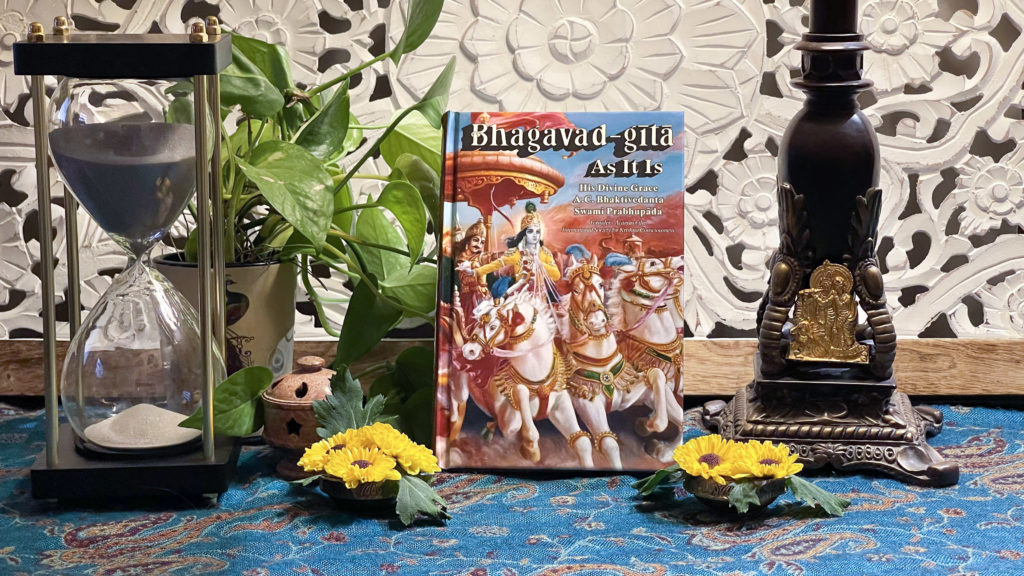
Bhagavad-gita As Is Is is translated purely from the original Sanskrit by His Divine Grace A. C. Bhakivedanta Swami Prabhupada and includes purports that are taken from commentaries of previous self-realized spiritual teachers. In this volume, we find transcendentally poetic insights and instructions that clarify our placement in this body and in this world, and direct us to the purpose of life.
Bhagavad-Gita is part of the great historical narrative called Maha Bharata, or the History of Greater India. Bhagavad-gita itself is a chapter from that history, and is the most important chapter of that epic work. Bhagavad-gita means “Song of God,” and it is the instructions of Lord Sri Krsna to His dear friend Arjuna, as they sit on a chariot between the two great armies getting ready to fight the most significant Battle of Kurukshetra. Arjuna has become bewildered about the inevitable war and his own duties as a natural warrior. He has become weak hearted, and the Lord offers straightforward and strong spiritual counsel in His own poetic words.
BG 2.11-25
“The Blessed Lord said: While speaking learned words, you are mourning for what is not worthy of grief. Those who are wise lament neither for the living nor the dead. Never was there a time when I did not exist, nor you, nor all these kings; nor in the future shall any of us cease to be. As the embodied soul continually passes, in this body, from boyhood to youth to old age, the soul similarly passes into another body at death. The self-realized soul is not bewildered by such a change. O son of Kuntī, the nonpermanent appearance of happiness and distress, and their disappearance in due course, are like the appearance and disappearance of winter and summer seasons. They arise from sense perception, O scion of Bharata, and one must learn to tolerate them without being disturbed. O best among men [Arjuna], the person who is not disturbed by happiness and distress and is steady in both is certainly eligible for liberation. Those who are seers of the truth have concluded that of the nonexistent there is no endurance, and of the existent there is no cessation. This seers have concluded by studying the nature of both. Know that which pervades the entire body is indestructible. No one is able to destroy the imperishable soul. Only the material body of the indestructible, immeasurable and eternal living entity is subject to destruction; therefore, fight, O descendant of Bharata. He who thinks that the living entity is the slayer or that he is slain, does not understand. One who is in knowledge knows that the self slays not nor is slain. For the soul there is never birth nor death. Nor, having once been, does he ever cease to be. He is unborn, eternal, ever-existing, undying and primeval. He is not slain when the body is slain. O Pārtha, how can a person who knows that the soul is indestructible, unborn, eternal and immutable, kill anyone or cause anyone to kill? As a person puts on new garments, giving up old ones, similarly, the soul accepts new material bodies, giving up the old and useless ones. The soul can never be cut into pieces by any weapon, nor can he be burned by fire, nor moistened by water, nor withered by the wind. This individual soul is unbreakable and insoluble, and can be neither burned nor dried. He is everlasting, all-pervading, unchangeable, immovable and eternally the same. It is said that the soul is invisible, inconceivable, immutable, and unchangeable. Knowing this, you should not grieve for the body.”
Without spiritual wisdom, no one can have a complete picture of this world, let alone the entire creation. Without spiritual wisdom, one is limited in his understanding and perception. With spiritual wisdom, handed down from the Lord Himself through a pure lineage of spiritual teachers, one can become free not only of the tribulations encountered in the human form, but from the sufferings, over many millennia, in the cycle of birth and death, through many species of life. As only the human being can read and study the great literary artists, only the human being can inquire about higher truths and become set free from repeated births and deaths in the material world. No animal can read and study Shakespeare, and in the same way, no animal can read, study, and understand the greatest of literary gifts, those that present us with the unadulterated science of the soul in relation to the Supreme Personality of Godhead. This human form of life is therefore a blessing that is not meant to be wasted to lesser pursuits than the reawakening of our real spiritual nature in relation to God.
BG 2.51
The wise, engaged in devotional service, take refuge in the Lord, and free themselves from the cycle of birth and death by renouncing the fruits of action in the material world. In this way they can attain that state beyond all miseries.