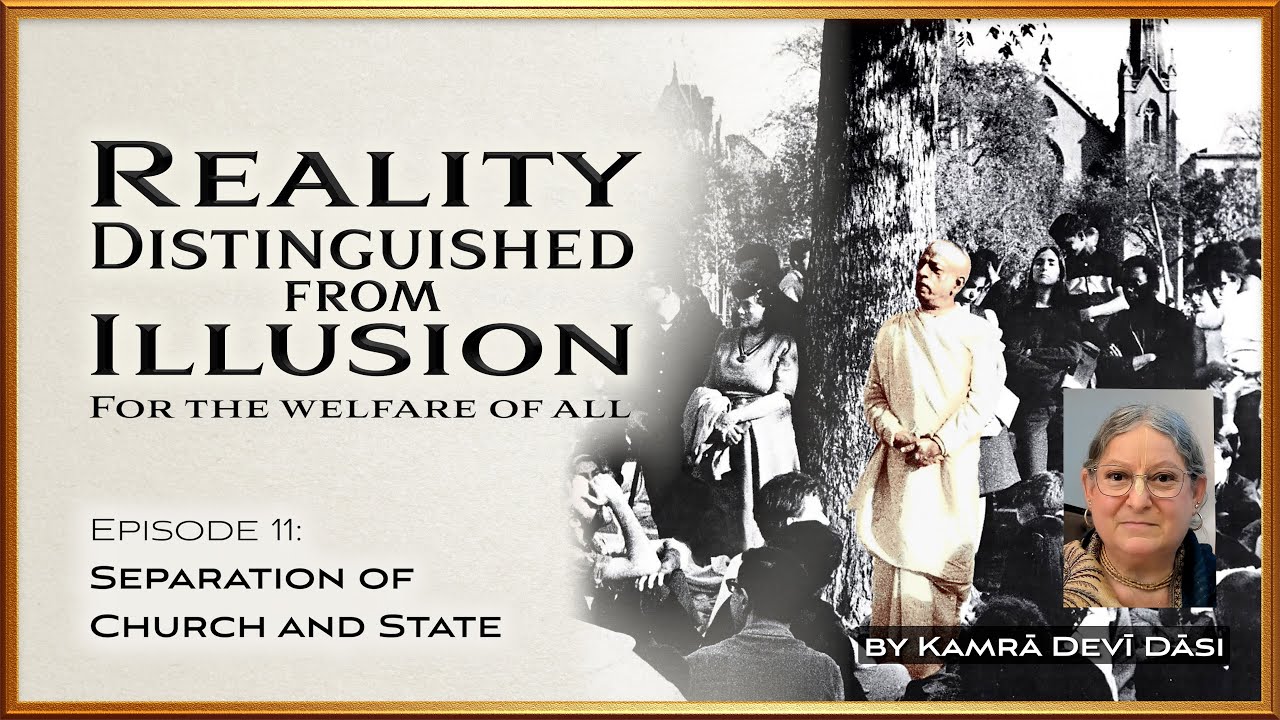
Welcome to the Purely Prabhupada YouTube channel. This video series is called “Reality distinguished from illusion for the welfare of all.” My name is Kamra devi dasi, and I am a disciple of His Divine Grace A.C. Bhaktivedanta Swami Srila Prabhupada.
This is the eleventh video of the series. It is called “Separation of church and state.”
Separation of church and state essentially means that the government cannot impose a certain religious doctrine or sectarian structure upon the populace. This principle, derived from the first amendment of the US Constitution, is there to give some protection from a government that by nature, will try to control the citizens rather than serve and protect them. Regarding religion, this can mean the government enforcing or requiring that the citizens adhere to a certain religion, sponsoring a certain religion, or even creating a state religion that requires adherence. The leaders must encourage people in their religiosity but not demand a certain religion.
Life, liberty, and the pursuit of happiness. This is a phrase from the United States Declaration of Independence. It states that these are rights given by God and should be protected by the government. It is not a legal statement, but is put forward to inspire what was seen by the founding fathers, especially Thomas Jefferson, as the basis of good government.
But there must be religiosity, or at least morality, or the pursuit of happiness devolves into degradation, and the society becomes ungovernable, like a chaotic mob of uncontrolled, wild animals. The citizens must be protected from their lack of sense control by enforcement of basic moral codes.
There must be separation of church and state, but there also must be Godly leaders who take counsel from Godly men. In the ancient, but very relevant, Vedic system of Varnasrama, citizens are engaged in works according to their psycho-physical natures. This is not determined by birth, as is misunderstood in the caste system of India, for example, but by qualities. This keeps society running smoothly, as everyone is happily engaged according to their natures, skills, interests, and natural talents. Higher than varnasrama, though, is the system of daivi varnasrama, where the focus of the entire society is upon gradually coming back to the purpose of real religion, reawakening love of God. There is the priestly class, known as brahmins, and they direct the society especially by guiding the class of government leaders in instituting and upholding moral and religious practices.
Real religion is a science. It is not sectarian. It does not fall under any designation. It teaches that we are not this body, but that we are eternal servants of the Supreme Lord even though we experience many births and deaths. It teaches that we must all suffer birth, death, disease, and old age, no matter what is our religion. It teaches that we must suffer from others, from our own bodies and minds, from acts of nature, because we are in a place that is not really our home, but rather in a place that is contrary to our real nature as pure spirit souls. The purpose of the suffering is for us to understand that we are not denizens of this material world, but of the eternal kingdom of God. And it teaches us, with proper guidance, how to go back to our real home after leaving this body, making this death our last one in a long sojourn of repeated births and deaths, in many species of life, in this material world. This religiosity must be encouraged, it must be taught.
But hypocrisy cannot be tolerated in the name of religion. Religions must be studied to assure that they are guiding people correctly and that there is a purpose to any rituals that are performed regionally. For example, I was raised in a community that refused to allow you to take off your shoes in the house except when you slept, no matter how much dog remnant or how many petroleum puddles you had stepped in on your way home from school, seeing being shoeless in the house as a sign of lacking or mourning. Yet, this same sect insisted on male genital mutilation as a requirement for cleanliness and acceptance. It always was puzzling to me, and the religious leaders could never explain in it any satisfactory way. And as I grew up and entered into natural health coaching, I became aware how deeply many men had been affected, even into their senior years, by the vulnerability, the helplessness, the rage at the violation of their bodies, as infants. I’m sure there are many other examples, and these type things need to be looked at by those who are actually wise and objective, and who can guide others to what is real religiosity and what might be simply ritual, or even harmful ritual, so that human society can progress on the real path of the restoration of love of God.
So, the pursuit of happiness… At best, in this world, happiness is temporary. Real happiness is not of this world. Real happiness is found in the eternal, blissful kingdom of God only. The duty of proper government is to direct people to real happiness, to their real home. In order to be effective, they themselves must be followers of the science of self-realization, the science of going back to godhead, and practice the principles themselves, free of duplicity and hypocrisy.
Bg. 3.21 Whatever action a great man performs, common men follow. And whatever standards he sets by exemplary acts, all the world pursues.
Purport
People in general always require a leader who can teach the public by practical behavior. A leader cannot teach the public to stop smoking if he himself smokes. Lord Caitanya said that a teacher should behave properly before he begins teaching. One who teaches in that way is called ācārya, or the ideal teacher. Therefore, a teacher must follow the principles of śāstra (scripture) to teach the common man. The teacher cannot manufacture rules against the principles of revealed scriptures. The revealed scriptures, like Manu-saṁhitā and similar others, are considered the standard books to be followed by human society. Thus the leader’s teaching should be based on the principles of such standard śāstras. One who desires to improve himself must follow the standard rules as they are practiced by the great teachers. The Śrīmad-Bhāgavatam also affirms that one should follow in the footsteps of great devotees, and that is the way of progress on the path of spiritual realization. The king or the executive head of a state, the father and the schoolteacher are all considered to be natural leaders of the innocent people in general. All such natural leaders have a great responsibility to their dependents; therefore they must be conversant with standard books of moral and spiritual codes.